
01
"How many?" is the base rule
The board shows the same digit several times. Under the base rule, tap the button for how many digits are displayed — not the digit itself.
COUNT
The trick is suppressing the urge to read the digit
"4 4 4" — how many? A counting-Stroop time attack where you suppress reading the digit and answer with the count.
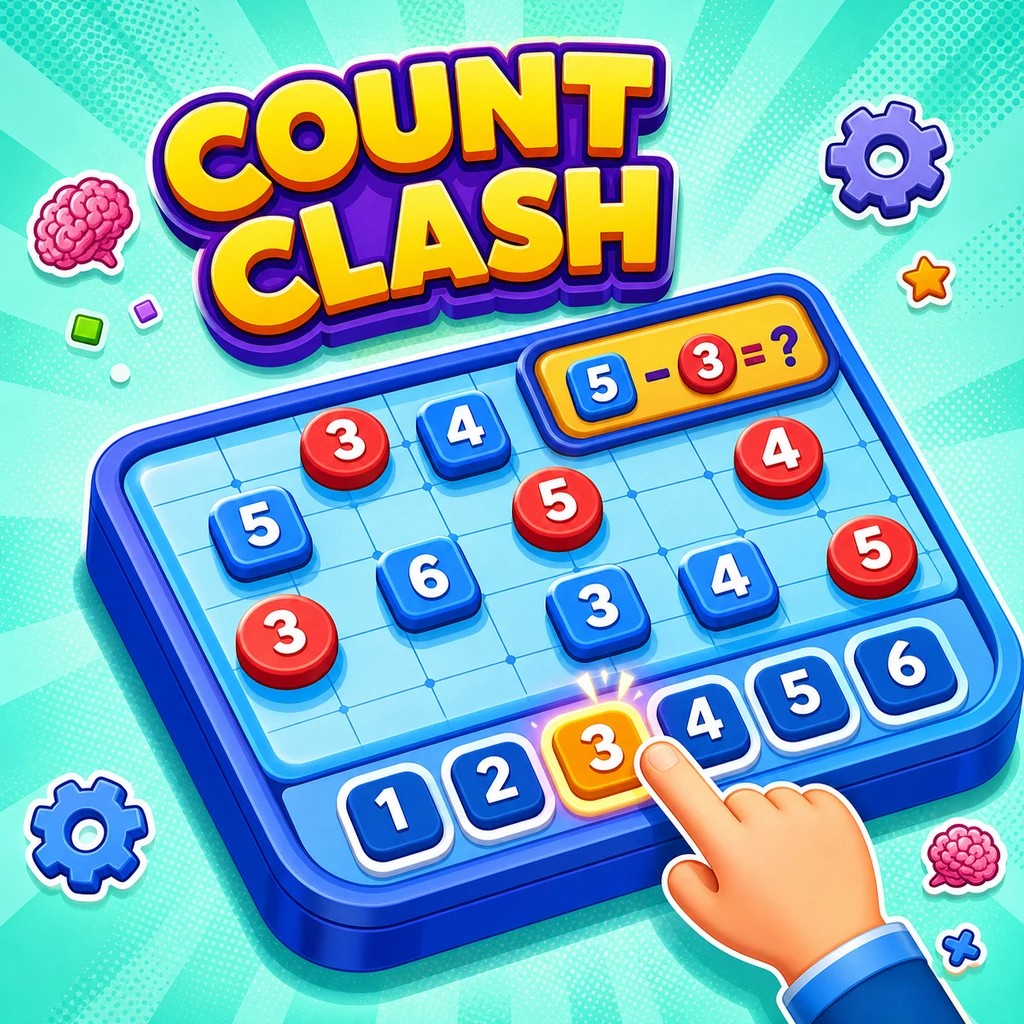
Count Clash is a counting-Stroop inhibition game: the board shows the same digit several times, and you answer by the current rule — "How many?", "Which digit?", and more. Suppress the automatic urge to read the digit and tap the right number fast. There is no game over; each wrong answer adds +3 seconds to your total time. Higher levels widen the number range, add more questions, scatter the layout, and mix in add/subtract rules.
The board shows the same digit several times. Under the base rule, tap the button for how many digits are displayed — not the digit itself.
From level 3, "Which digit?" questions that ask for the written digit itself are mixed in. Check the rule banner before answering each question.
As stages advance, "Add (digit + count)" and "Subtract (digit − count)" rules join in.
Red and blue pieces appear as stages advance. Later rules ask for red count, blue count, all minus red, or red minus blue.
A wrong answer never fails the run, but each miss adds +3 seconds to your total time. The same question stays until you answer correctly.
Each stage is a streak of 5–7 questions. Your score is the total time (elapsed + penalties) until all questions are answered. Later levels scatter the digits and vary their sizes.
99 stages total. Every 11 stages, the level increases.
| Level | Stages | Range | Questions | Rules | Layout |
|---|---|---|---|---|---|
| 1 | 1–11 | 1–3 | 5 | 1 | Aligned |
| 2 | 12–22 | 1–4 | 5 | 5 | Jittered |
| 3 | 23–33 | 1–4 | 6 | 6 | Light scatter |
| 4 | 34–44 | 1–5 | 6 | 7 | Light scatter |
| 5 | 45–55 | 1–5 | 6 | 7 | Light scatter |
| 6 | 56–66 | 1–5 | 7 | 7 | Scattered |
| 7 | 67–77 | 1–6 | 7 | 8 | Scattered |
| 8 | 78–88 | 1–6 | 7 | 8 | Scattered + sizes |
| 9 | 89–99 | 1–6 | 7 | 8 | Scattered + sizes |
Rapidly cycling from grasping the count to tapping trains processing speed.
Counting while holding the current rule in mind trains working memory.
Accurately switching rules and doing quick mental math trains reasoning and calculation.
Suppressing the automatic urge to read the digit and answering by the rule trains response control.
Choose a Time Attack


Read these next to connect the full picture of cognitive measurement and training.